FACHELLI RED
The Reds
Fachelli · Garbonzo · LombardoFachelli strategy and treasury, Garbonzo workshops and Lombardo protection form the red bloc.
1920s–1940s · before Montaro
The Reds follow Fachelli and the Blues follow Vespucci in the 1935–1940 civil war. This is the generation of Enzo’s father and Vito’s grandfather; new loyalties divide descendants of the old Houses.
Established premise · setting in developmentTHE CREST IN THIS ERA
The Reds rally to Fachelli; the Blues to Vespucci. Descendant families retain their symbols while taking the color of their wartime faction.
The 1935–1940 civil war turns the family seals Fachelli red or Vespucci blue. Luciani retains a neutral field as the impartial keeper and peace broker. These colors belong to this conflict, not the ancestral holds.
Follow the changing crests ↗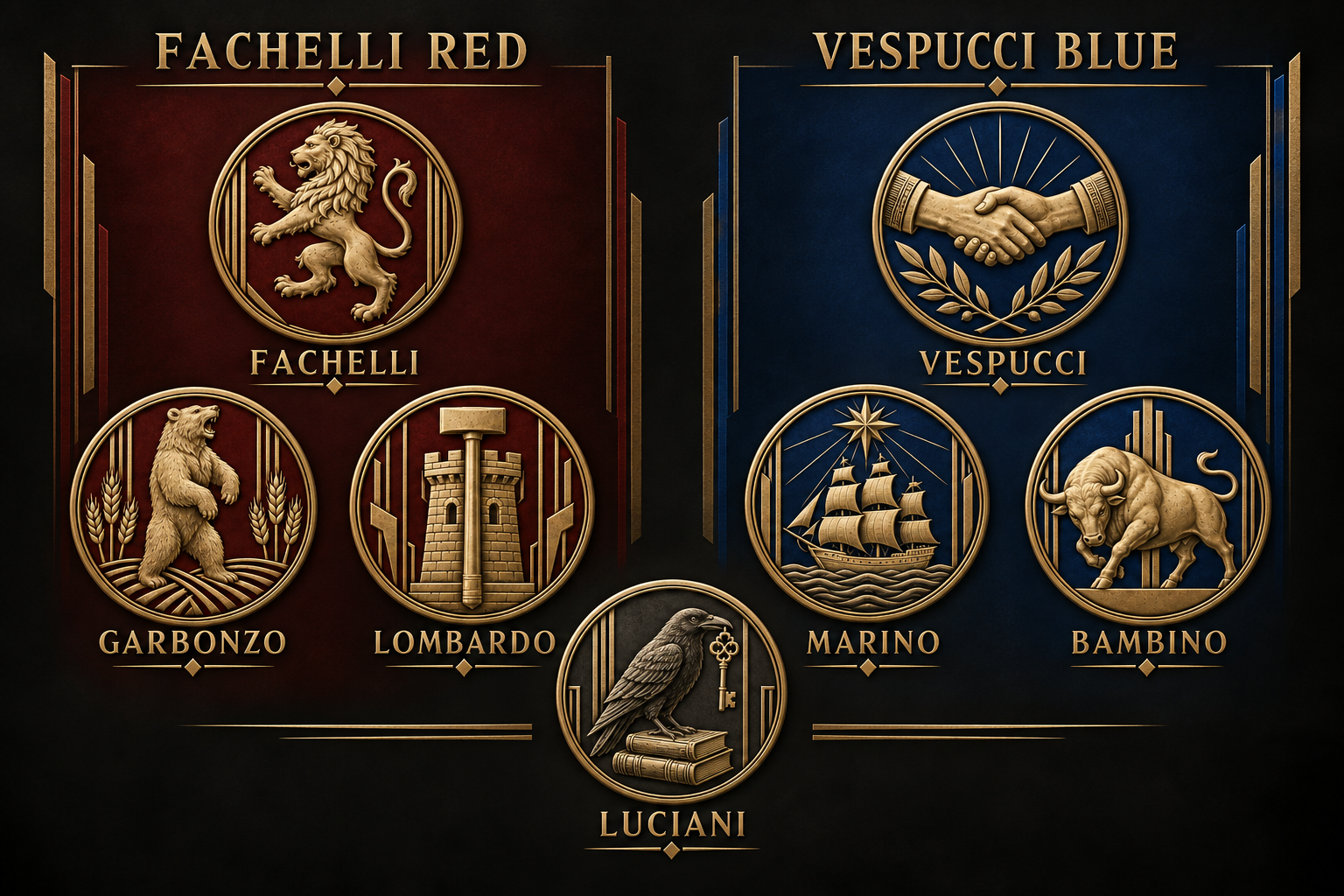
1935–1940 · A FAMILY DIVIDED
The Family divides into two factions: the Reds rally to Fachelli, the Blues to Vespucci. Each aligned family keeps its inherited symbol but adopts its faction’s red or blue field. The colors identify a wartime allegiance, not a new bloodline.
FACHELLI RED
Fachelli strategy and treasury, Garbonzo workshops and Lombardo protection form the red bloc.
VESPUCCI BLUE
Vespucci leads the blue bloc, joined by Marino operations and Bambino supply and distribution.
THE RECORD BETWEEN THEM
Luciani preserves accounts from both sides and remains outside the fighting blocs. Its exceptional intervention brokers the peace in 1940.
Working supporting-family alignment: three red, three blue, with Luciani neutral. Fachelli and Vespucci leadership is established; individual defections, dates and terms of allegiance remain to be developed.
The established dispute is control of the second territory and the common Family’s authority, revenue and obligations. The factions disagree over who can govern and on what terms. The immediate incident, contested assets and failed negotiations still need to be recorded; a color alone is not a reason for war.
The five-year war nearly destroys Garbonzo and Bambino. Luciani brokers peace in 1940, establishing the seven-seat Commission. A shared representative system replaces the struggle for supremacy, while the survivors carry its losses into later generations.
Vespucci leads the Blue faction in this era. Its ancestral role as a neutral treaty and banking House remains Vardessa history; that neutrality is not carried unchanged into the prohibition civil war. Marino remains the ancestral coastal rival, but is not the opposing head of this later war.
The ancestral colors remain in the archive. Red and blue identify the wartime factions; the inherited symbols still identify the family.
PROHIBITION → MODERN
His father belongs to the prohibition era. Enzo’s modern story remains a later generation; dates and ages must be reconciled before a dated biography is written.
PROHIBITION → MODERN
His grandfather belongs to the prohibition era. The intervening parent and exact branch are unrecorded. This is modern Vito’s ancestry, not Vito Vespucci VII’s space-era biography.
PROHIBITION · LORE
Generations removed from Vardessa, the descendants become crime families and syndicates. Loyalties shift: Vespucci leads the Blues against Fachelli’s Reds, a departure from its ancestral neutrality. This is Enzo Fachelli’s father’s era and modern Vito Vespucci’s grandfather’s era. The 1935–1940 Red–Blue Civil War between Fachelli and Vespucci nearly destroys Garbonzo and Bambino before Luciani brokers the settlement.
The Second Divided Crown is a historical power struggle, not the present-day Family structure. Its territory remains under development; it is not Montaro.
THE CODE IN THIS ERA
These are roleplay principles for this setting. Current community standards, consent and host-game rules apply across every era. Additional chapter rules require Commission review.
Community standards ↗Associate → entrusted specialist → crew or division head
The 1940 settlement establishes seven House representatives electing Don, Underboss and Consigliere. Earlier scenes must not use that Commission as an existing institution.
Confirm the territory, households and local prohibition chronology. Develop the terms of the red and blue alliances and the unnamed father and grandfather; preserve the 1940 outcome.
Read the historical archive ↗WHAT THE GENERATIONS KEEP
Carry the family name through conduct, craft and obligations fulfilled. Prestige is earned over generations.
Make room for guests, introduce newcomers properly and build relationships over shared time. Italian family culture informs the fiction without prescribing how real people must behave.
Let quality, patience and a kept word speak. Old money is expressed through stewardship, restraint and care for what the next generation inherits.
Learn the stories, preserve the songs and remember who made the present possible. Respect for elders leaves room for younger generations to question and change the code.
Names, sayings and family lines endure; institutions, loyalties and customs evolve. No descendant is obliged to repeat an ancestor’s feud.